CLIENT
Military clients
LOCATION
Worldwide
YEAR OF COMPLETION
1999-now
SURFACE
2700 m2
MATERIAL
Thick-walled GRP or CFRP
Since 1999, our new technology has enabled us to produce composite sonar domes in one piece. Until then, sonar domes were either made of metal or glued together from multiple (composite) parts.
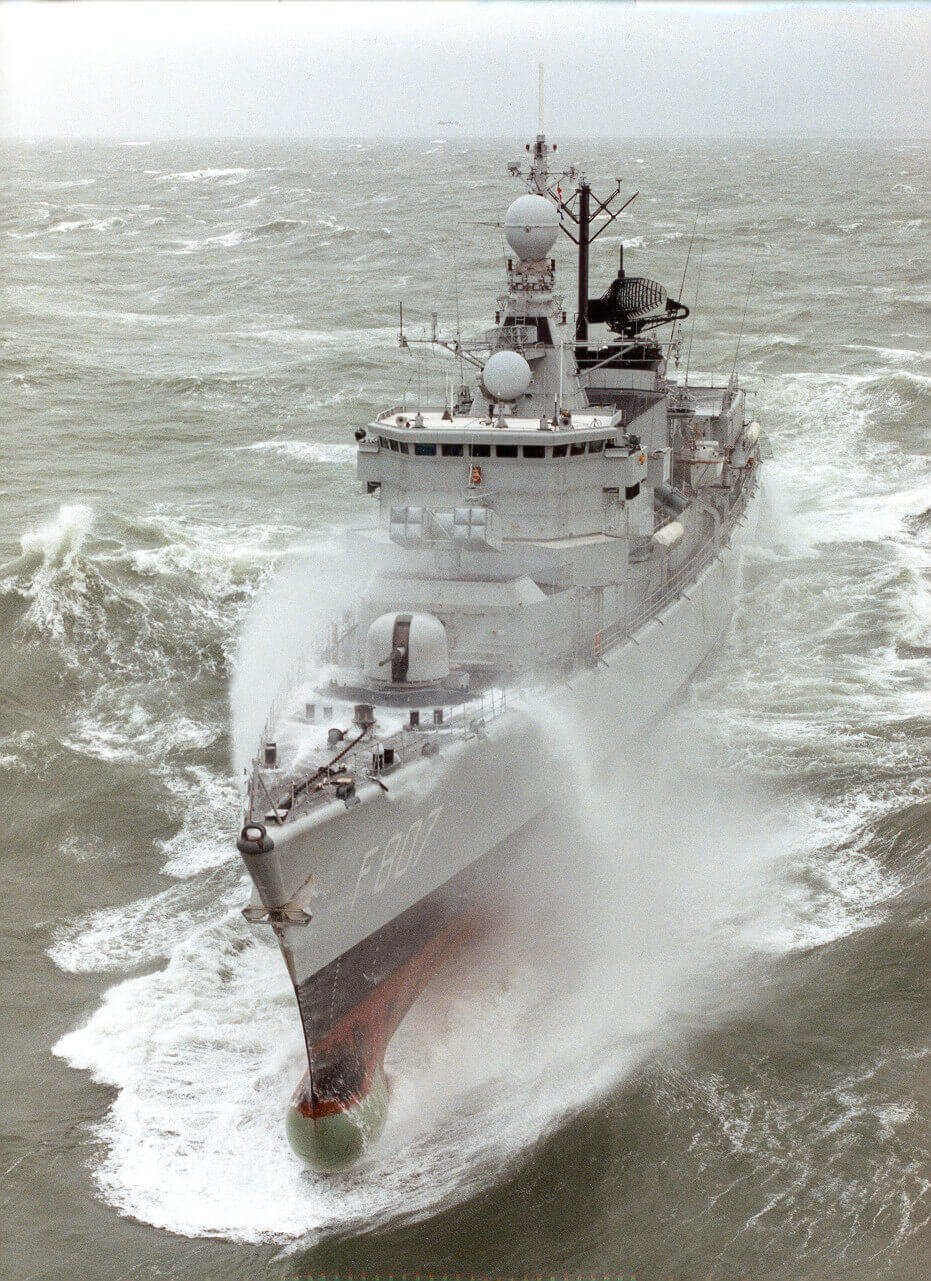
One of our specialties: making large, complexly shaped, thick-walled composite sonar domes in a single production run. In 1999 Holland Composites developed a new technique to produce sonar domes - the protruding spherical part under the foredeck of large (war) ships/ frigates, housing the sonar. Until then, sonar domes may have been made of metal, or glued together from multiple (composite) parts.
To search underwater, sonar technology is used. There are two types: active sonar and passive sonar. An active sonar emits a sound: if the sound collides with an object, it bounces back. With that data, you can determine that something is present and roughly where. A passive sonar emits nothing, but listens only for ships or submarines that make noise.
Warships like frigates generally use active sonars because they themselves (hull, machinery and propellers) make too much noise to use passive sonar properly. So the underwater world is a world of sound: whoever is quietest and/or can hear farthest wins.


We produce a single composite structure - without a secondary joint - with a wall thickness of 20 to 80 mm, which protects the sonar installation from impacts and vibrations.
Known advantages of composite are strength and rigidity at a relatively low weight, as well as longer service life and minimal maintenance. Another big plus is that the density of a composite laminate is closer to the density of water. As a result, the speed of sound propagation is less affected, leading to better data. Further optimization is possible by producing a partially viscoelastic laminate.
With materials such as E-glass and a hybrid vinyl ester/epoxy resin, we manage to achieve a high fiber volume content of 70% with the vacuum injection process. This results in a robust and cost-effective product.
Other important properties are the absence of air inclusions (airvoids) in the laminate and the very uniform wall thickness. As a result, minimal interference on the reliability of the sonar data occurs.
Related projects

Biobased bouwen krijgt vorm in Delft